
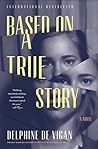
 Based on a True Story by Delphine de Vigan
First and foremost, Delphine de Vigan's Based on a True Story is a gripping suspense tale. Two, a story based on a true story may or may not be true.
Many reviews of de Vigan's book this season will note both of these points and will go into detail about one or both of them. Critics (and readers) are always interested in learning more about the tale behind the fiction, and in this case, the author gives the tease right away. She continues in this vein by giving her narrator the name Delphine and portraying her as a middle-aged Parisian writer who has recently achieved great success with a tell-all memoir about her family, much like the real-life de Vigan did with her 2012 book Nothing Holds Back the Night, in which she attempted to reconstruct her mother's mental illness.
Unfortunately for both de Vigan and her Delphine, the memoir was met with strong hostility from family members. Based on a True Story opens, Delphine is tormented by whether or not she should have written her final novel. She's wary and can't seem to compose even a single sentence. When an acquaintance, professional ghostwriter L. (whose name we never learn), pushes their friendship to the point where she's moved into Delphine's apartment and is not only signing her name on checks but also posing as her physical double at literary events, it appears there's just one way out.
L. wants Delphine to get back to the document, and right fast, L. believes that albums anticipate novelists to " lay their guts on the table. " When albums are not aflutter about whether or not. Will wind up laying Delphine's guts on the table, they may consider de Vigan's metafictional purpose in casting this book. Definitely, she's playing with the idea of who tells a story and how — especially in the scenes where Delphine receives unsigned nastygrams from a relative about why she shouldn't have written her anterior book.
Notwithstanding, the story she tells that fascinates me is the one of feminine brotherhood gone wrong, of a woman, was taken emotional hostage by another. Not since Samantha Harvey's masterful Dear Pincher has there been such a painful evisceration of connection. AsL. Takes control, Delphine relinquishes it, true, but that does not mean she wants to evanesce. She tells us unseasonably on that as a child, and she abominated her birthday fest because she disliked all the eyes " concentrating on me, the communal emotion. "L. takes advantage of Delphine's claim to duck the public eye, and for a long while, it works. " I could not wait to go into purdah, " Delphine says, primed for the elegant, organized strength ofL., a woman who seems to be in a vacuum. Where does she live? How does she choose her beautiful clothes? What does she really want from Delphine?
Yes, all of these further point us to the principles of quiescence in Rested on a True Story. But they also point us to how and why Delphine becomes entangled inL.'s web. When women meet and result in kindliness, there's a certain quiescence in figuring out their separate tasks. Who teaches, who learns? Will, a new friend, help you wax smarter, more swish, more connected? Will that friend be someone you see or speak to on a quotidian warp, or possibly just an untold times a while?
.
this is a story of vampirism, but the emotional kind.
" I must say that with her I was nowise bored, " Delphine tells us towards the book's midpoint, and that is because between the musketeer's nothing is proscribed, especially those motives that society eschews — how to be a woman at twilight, how age affects status, what women can write about that men can't. " The power of lodestone. Plied on me was probably all of this. I esteemed her for her clear-sightedness about the world and herself and her competence to the palisade to play the game. " Delphine hates the game and does not want to play it, but that willful blindness leads to real trouble asL. Takes over more and more of her life.
The red alert, Delphine knows now, was when she came to believe. She was the only person who could understand her. She knows why, too. Multiple pens, at twilight, have children grown and flown, mates busy with their own careers, and confidants scattered to the four winds. It's easy to believe that a person who " fits " you is the answer to your segregation. In the novel's ( biography's?) second half, we'll see that belief unravel fast. Notwithstanding, compilations should nowise forget Delphine invited. Into her life — this is a story of vampirism, but the emotional kind.
View all my reviews

0 Comments